McIntosh Marketing Blog

Ten AdWords Questions To Make You More Money

AdWords is deceptive.  Where as programming a website appears complicated and a subject most people would never attempt, AdWords seems approachable.  But in programming, you learn from your mistakes and never lose a penny.  AdWords mistakes, on the other hand, can cost thousands of dollars and can incur penalties that can never be overcome.

I find myself asking the same AdWords questions to every potential client.  In the hopes of improving everyone’s campaigns, I will list my general questions here, along with the typical answers I receive.

1.  Are you happy with your results?  Is your campaign profitable?

Normal Answer:  “Not really – no.” I haven’t spoken to a person yet that was happy with their results, although I have seen profitable yet wasteful ones. I have seen one client throwing away thousands of dollars a week.  That account had so many things wrong that I just told them to turn their account off.

2.  Who set up your AdWords account?

Normal Answer:  “I/We did.  Why?”

If the client set it up themselves, that tells me that there are most likely penalties or mistakes that need to be fixed.  It also gives me an idea of their skill level and what the rest of the answers to my questionnaire would be.
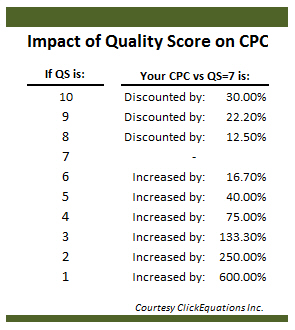
3.  What is your quality score?

Normal Answer:  “What is ‘quality score’?”

(This is a number from 1 to 10 that measures the “quality” of a given ad)

Most clients don’t know where this information is since Google hides this information from view.

If the quality score is below 7/10,  you are incurring penalties and don’t even realize it (see chart)

4.  Where are you sending people that click on your ads?

Normal Answer:  “Our home page”. The correct answer, of course, is a dedicated landing page for the specific keyword group.

If you sell computer supplies, you may have a keyword group called “keyboards”.  You would then want to send someone to the web page:  http://www.mydomain/keyboard which shows them all your keyboards, NOT to your home which makes them take an additional step to find what they need.

5.  What is your CTR (Click-Through-Rate)?

Normal Answer: “Not good – less than 1%”. By itself, this statistic doesn’t mean much.  Usually, the higher the CTR, or the higher the number of users click your ad vs. just look at it, the better your Quality Score, the cheaper your ad cost, and more profitable your campaign.

6. What is your conversion rate?

Normal Answer: “What is conversion rate?” (This is the ratio that measures the number of people that complete a purchase or signup to a newsletter vs. the amount of people that just click your ad and do nothing.)  Since understanding conversion rate is paramount to having a successful keyword campaign, this is a bad sign.

Once you have enough conversions, you can start to weed out keywords that under-perform, and find more that do.

7.  What are you setting as your “goal” to base your conversion on?

Normal Answer:  “When they buy our product.” This is a legitimate solution, however, we additionally always try to capture the “lead” goal so that we can capture the users identity so that we can email them later if they don’t complete the purchase.

8.  How many ads do you have running for each ad group?

Normal Answer:  “One.” You should always be running at least 3 ads for a given ad group.  At any given time, you can throw out the worst performing one and replace it with one you hope will beat the other two.

9.  What is your budget?

There is no correct answer to this question.  This is just to flesh out whether they are turning their account on or off repeatably (a big no-no), or hitting their maximum limit for the day at 2 AM.

10.  Are you using negative keywords?

Normal Answer: “Huh?”  Negative keywords allow you to NOT bid on certain words that show up in a phrase.  A common problem are song or band names.  You may want to bid on the keyword “cocaine” as in “cocaine abuse”, but you don’t want “cocaine clapton mp3”.

A major part of optimizing a campaign is finding and using negative keywords to limit any wasted funds.

Read more »

Tags: , , , , , , , , , ,

Web Marketing & Sun Tzu

I have always been a fan of Sun Tzu’s treatise, The Art Of War.  But when I recently watched the History Channel’s presentation on this world-renowned book, it made me think how most businesses do not apply it.

One would need to watch this TV version of the book as a good start, as well as read the book itself. ( I recommend the James Clavell version)  But one thing stuck out for me above all else and that was to attack an enemy’s weakness despite one’s size. In this case size does not matter. In other words, any guerrilla force can be effective if they are stealthy, consistent and attack the enemy’s weak spots.  And everyone has at least one.

In marketing, I hear to often about how they have a small budget, no sales people, lower revenue and on and on. In other words, they have not realized that they have to adapt and become a guerrilla marketer. And no where else can this be done more effectively than the web. This is because of two major factors:

1. The internet has evened the odds, more than any other factor in business. You may be operating from your home, or even while eating a muffin at your local coffee house, but your potential client cannot tell that by looking at your web site.

2. About 90% of the companies, big and small, are either not utilizing all possible methodologies and tactics or are making big mistakes that is costing them SEO and SEM potentialities.

The guerrilla marketer does not look at what he or she does NOT have. They look at their competition’s weakness and develop practical ways to exploit them.  Most companies do not blog often. This is a weakness. Most companies do not submit articles or use online PR distribution channels. This too is a weakness. There are hundreds of examples of weaknesses to be found.

Based on this knowledge, one can then develop tactics that would make Sun Tzu proud and your banker even happier with all the profits generated with your online marketing campaign.

Ancient knowledge is still as applicable as it was today, even in the world of internet marketing.

Read more »

Tags: , , , , , , , , , , ,

Marketing With Effective Google Ads

You must follow certain rules in writing a good Google Ad. Many people have made the mistake of stuffing keywords to find out that this strategy can be costly by attracting the wrong types of public who are not inclined to buy or take action.

From our experience with Google AdWords, SEO and SEM, these are key points to follow:

  1. Your grammar, spelling and punctuation must be perfect. Capitalize the first word in each sentence.
  2. Provide four lines of text with no pictures.
  3. Your first line must be limited to 25 characters.
  4. Be as specific and precise as possible.
  5. Lines two and three must be 35 characters each.
  6. Use keywords twice more when possible.
  7. Tell users why they MUST have your product. Have a “call to action”.
  8. Cite statistical information and facts.
  9. When you are selling something, include the price.
  10. Use your third line for a “call to action”.
  11. Line four is for your destination URL. You must place your URL within the ad itself.
  12. Sell your benefits with power words and hot buttons.
  13. Write in simple, everyday words.
  14. You must utilize keywords within the ad itself.
  15. Test, Test and Test. Place many ads simultaneously and test which is best.

Google Ads can be a powerful and profitable means to driving people to your website and to generate a lot of sales and profits. Use them right and you will find that your Google Ads strategy could be your biggest edge against your competition.

Read more »

Tags: , , , , , , , , , , , ,

The Big Three of Internet Marketing

The Big Three has meant for decades, “GM, Ford and Chrysler”. But with their problems comes the next evolution of that term, particularly when talking about web marketing, SEO and SEM.

The Big Three in the internet marketing world is Facebook, Google and YouTube. Make it big with these three media giants and you will make it big in business. Let’s be real. Facebook is social media, Google is how you find almost anything and YouTube is the new TV. Hopefully you are gearing your mind-set, your marketing budget and how you interface with the world’s newest Big Three.

Read more »

Tags: , , , , , , , , , , , , , , , , , ,

The Burger Wasn’t Delicious: Understand Social Bookmarking

So many terms, so many things to learn. Just when we started to understand social media (a work in progress), then someone throws out a new term like “social bookmarking.”

Yesterday I was with two friends. One was eating a burger and I talked about delicious. The other person was confused, thinking I was talking about the burger. She did not understand that delicious is a social bookmarking site. http://delicious.com/ This confirmed to my burger eating friend that this is a subject that is not only misunderstood, but has not been evaluated to its importance from a SEO and SEM standpoint.

In short, social bookmarking allows internet users o share, organize, search, and manage bookmarks of web resources. Unlike file sharing, the resources themselves are not shared, but merely bookmarks that refer them. These are saved as tag and allow people to share bookmarks, just as they would share an email address or a link to a video. It not only makes your bookmarks more manageable, but more sharable. I think sharable is a word.

Social bookmarking also has another benefit. You can specifically target what you want to find when surfing the web. Instead of going into a search engine and attempting to find that needle in a haystack, you can rapidly zero in on the items to what you are searching for.

From an SEO and SEM strategy, social bookmarking is another tool in your arsenal, hardly known about to the newbie or the common business person starting out into the web marketing world. The more often a web page is submitted and tagged, the better chance that web site has of being found.

To understand social bookmarking further, watch this video:

Read more »

Tags: , , , , , , , , , ,